



Visual literacy and graphic facilitation in adult education in Erasmus.
Learning how to use graphic facilitation is the greatest gift you can give to yourself and your work.
The good news is that you have just found the right place.
WHO ARE WE?
We are a team of trainers and facilitators with expertise in visual literacy and graphic facilitation. One of the things we do best is help people turn difficult situations into learning opportunities through creativity and stories.
With a marker in our hand, we know how to help people to carefully observe the world, even to change it, or to design strategies to deal with difficult situations.
We discovered European projects in 2012 by participating in the Grundtvig programme with a project called Common Stories of Europe, and became passionate about the world of non-formal education.
That project allowed us to grow professionally and soon afterwards we also discovered the world of Youth Work in Erasmus, within which we became trainers and facilitators.
Since then, we have been passionate about the Erasmus programme, and we are trying to grow further, personally and professionally. One of the topics we are exploring is the education of adults with fewer opportunities, which is directly attended to by the work we do on a daily basis in Genoa, Italy.
WHERE ARE WE?
The neighbourhood house ‘Casa Gavoglio’, a public space inside a former military barracks, is a cultural and civic centre that promotes the active participation of families, young people, and adults, in a peripheral and poor area of the city, lacking social, cultural and health services.
Our work with the local community aims to help people with fewer opportunities acquire skills (social, digital, cultural, civic participation).
In this space, we work with different target groups: children and pre-adolescents at school; young people; adults with fewer opportunities (families with migrant backgrounds; elderly people; patients of mental health services; people in socio-economically disadvantaged situations).
WHAT ARE WE DOING HERE?
One of our favourite topics, which we explore with all age groups, is visual literacy, that we can summarise as the ‘set of skills that enable an individual to find, interpret, evaluate, use and create images and visual media’.
The transition from this flow of information to the skill of understanding images and knowing how to create them in order to communicate can be practised with many activities.
One of these is graphic facilitation, a tool that helps people work better with the help of visual aids.
In our work with groups of all ages, we use it like this:
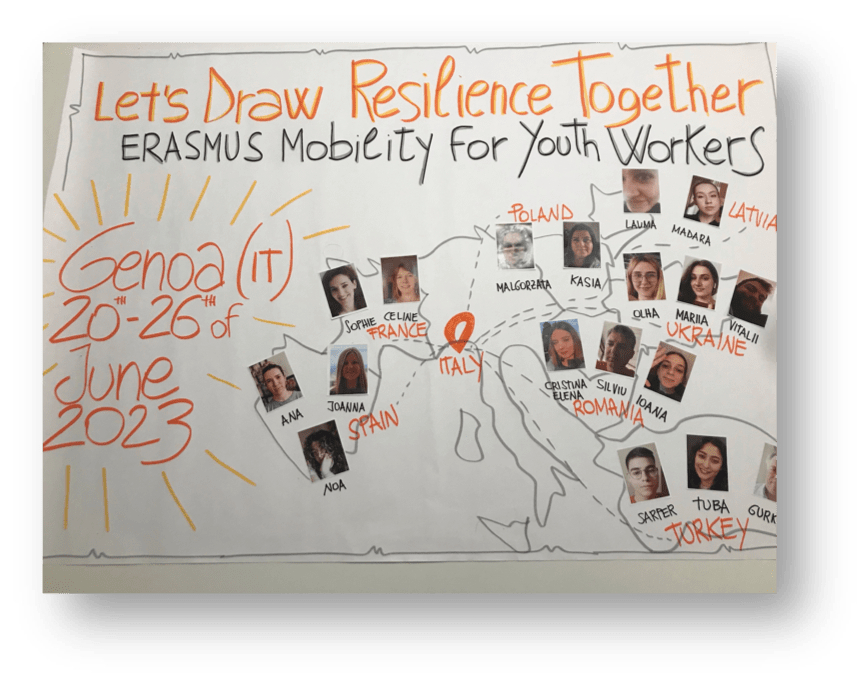


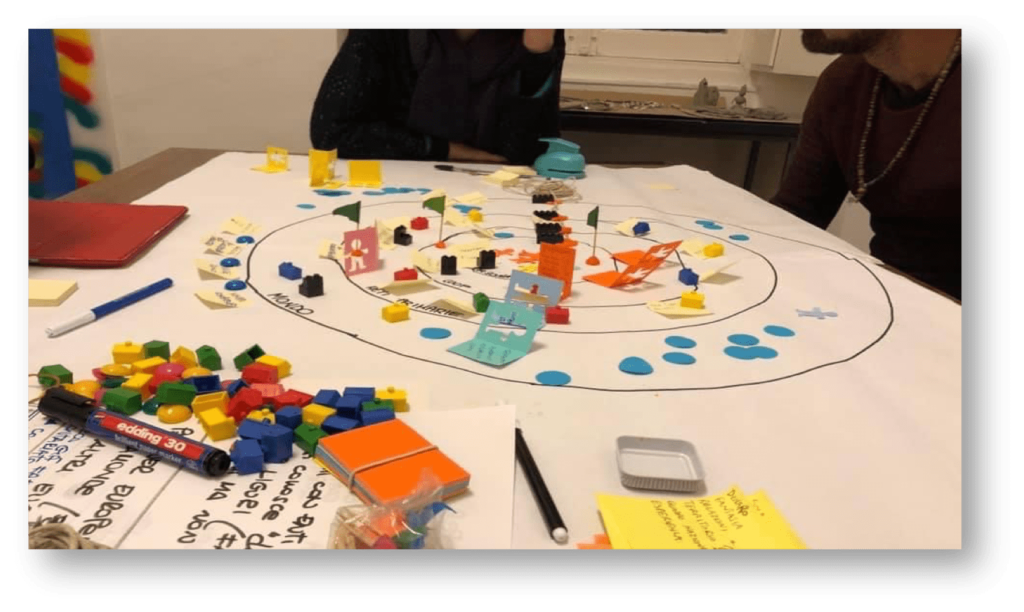
We like to sum it all up with the expression “Thinking with your hands”.
THINKING WITH YOUR HANDS
We taught visual literacy and graphic facilitation to teachers and adult education staff who came to Genoa to attend our courses.
As we always like to learn something new about the Erasmus+ programme, from 9 to 12 January 2024 we attended, through the NGO La Casa nel Parco ETS, a very interesting course organised by the National Agency of Romania ANPCDEFP, entitled InclusivE+ Mobilities.
For those of us who work with images every day, it comes naturally to take visual notes when we learn something new. Or, for example, when the facilitators of the InclusivE+ Mobilities course asked us to present our organisation in 2 minutes.
The difference between sharing verbally, or using slides with lots of text, and using quickly scribbled but clear and even funny sheets of paper, is obvious: for the listener that is a moment that reminds, that also engages emotionally, that makes you say: “Oh, if only I knew how to do that too!”
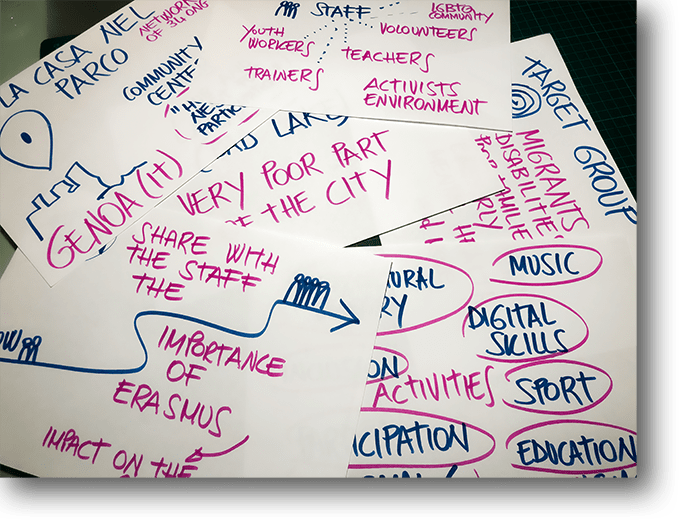
We love learning, we are big fans of life-changing lifelong learning and, at the same time, we are trainers who are able to offer an immersive, welcoming work experience that combines learning objectives with building new collaborations and friendships, as is happening with many people who decide to participate in our courses.
For the Erasmus deadline of 20 February 2024 we are proposing a training course for school staff and adult education staff, the description of which you can find here
THE APPLICATIONS OF GRAPHIC FACILITATION
In our opinion, also for personal growth, it is always a good idea to give yourself the chance to silence the inner critic that lives in everyone’s head and constantly tells you: “You can’t learn graphic facilitation, you can’t draw!”
The ability to draw and shape ideas with a felt-tip pen, in a matter of seconds, has changed our lives and taught us a profession. We like the idea of spreading this tool and these skills with our colleagues in the Erasmus world: it is one of the most fun and rich parts of our work.
One of the most interesting things about the InclusivE+ Mobilities course was the need to clearly cross-reference the needs of your users, the training your staff would need, and the priorities of the Erasmus+ programme. This intersection of information, for example, can be made clearer with the graphical facilitation of a Venn diagram.

Imagine drawing it on a large sheet of paper and facilitating a conversation with your colleagues, while everyone writes down their ideas on the paper. After an hour’s work you will be ready to present your staff’s Erasmus mobility project because you will all have clear ideas, and you will also have had fun. Did we make you want to learn? We hope so.
If you are also involved in adult education, you can check if your training needs include these, which are attended by our course:
- unlock your ability to draw, in order to express yourself visually
- learn about Visual Literacy and its practical applications in adult education
- involve people with learning difficulties
- design the storyboard of your lessons
- plan better with the staff of your organisation, discussing clearly the objectives of a project before you start writing it
- help people with fewer opportunities to learn better (e.g. by creating tools to teach second languages to migrant people)
- summarise an essay or lesson you are studying
- learn a new language, building your visual vocabulary
- set up the space where you work with adults so that it is welcoming and in order to share what you are doing
- help people appreciate what you are doing together (learning to learn)
- learn to draw, even without an artistic background, to communicate better
- explore urban or natural spaces, observing carefully and taking visual notes
- build a drawing diary, to keep track of your personal and professional development
- organise art workshops, to allow people to express themselves freely
- learn about silent books, and use them for dialogue and to imagine other illustrated stories
- use photographs and illustrations to facilitate a group
- use the third dimension to dialogue, to express ideas
Organising a mobility with us, in addition to the specific topics that you can learn more about through the courses, will also give you the opportunity to get to know an interesting public space for those involved in adult education.
We can also host a group of adults with fewer opportunities, planning with you activities to exercise visual literacy: drawing, art workshops, workshops with recycled materials, photography workshops, creative city exploration, storytelling with wordless picture books.
Write to us, and if you like we will schedule an online meeting to figure out how to collaborate.
