


Click here to learn about our course on Graphic Facilitation !
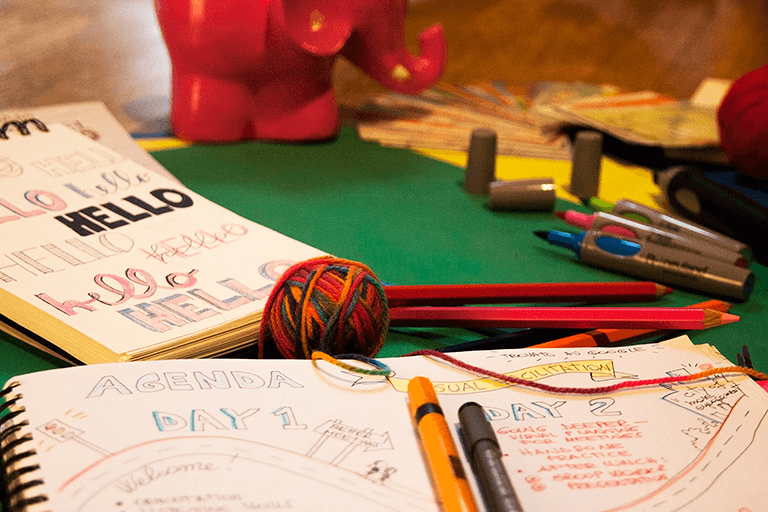
The training course in a nutshell
Our proposal is a training course for school staff and adult education staff, which lasts 7 days in person in Genoa. Before the course there are 2 online preparation meetings and a rich selection of material to study and practice on your own. At the end of the course, after a month, there will be the last online meeting, to help the group put into practice what they have learned at school and to disseminate the results of the project.
For 10 years, we have been using graphic facilitation and sketchnoting as tools to facilitate groups, to help people work better, to see more clearly the ideas produced by a group.
Very often, in school, drawing is used marginally, only in artistic activities.
Children draw spontaneously until they are 9-10 years old, and then they stop, because this skill is not cultivated and encouraged, especially at school. If, however, the practice of drawing is encouraged and cultivated together with school study, the learning results are incredibly high and especially for students with learning difficulties.
Our entire world, especially the digital one, is made up of images, which we can understand, use and produce to think and learn effectively, learning Visual Literacy through the practice of drawing and sketchnoting.
Have you always thought: I can’t draw?
Even if you think you don’t know how to draw (don’t worry, you’re in good company), thanks to this interactive course you will learn how to use Graphic facilitation in a simple way to make the learning process more inclusive and engaging.
Graphic facilitation is perfect for learners (from 6 to 18) with fewer opportunities (migratory background, learning difficulties, low social skills). Visual tools allow you to make learning visible and organize information in a simple and fun way, integrating the drawing also with digital tools.
When
We are planning to organize one course per month, from March to December 2024. As soon as we have confirmation of a group of at least 6 people, we will be able to confirm the dates.
| Topics | Visual thinking – visual communication – sketchnoting – graphic facilitation – tools for learning – learning difficulties – intercultural communication. | |||
| COURSE DESCRIPTION | This training offers different visual techniques as a way to enhance learning, motivation and involvement during your teaching and training activities. Graphic facilitation can be adapted to many different uses (didactic planning, classroom work, communication with families and stakeholders): they are particularly suitable in situations at risk of dropping out of school and to students with migrant backgrounds. Graphical tools are very useful in teaching a second language, English, Steam, Art, History, Digital competencies and Social skills. Participants will learn visual tools to adapt them to their work and specific contexts. | |||
| TARGET | The course is designed for a group of school teachers (working with students aged 6-18) as well as adult trainers, group facilitators, and educators specialising in learning difficulties. (Min 8 participants, max 15, from 2 or more different countries). The course can also be adapted to staff who work in adult education, especially with learners whit fewer opportunities: if you are interested in a personalized edition for you, write to us and we will figure out how to organize it based on your specific training needs. | |||
| LEARNING OUTCOMES | By the end of the course you will be able to: – Design visual tools to support learning – Use basic visual tools in different contexts and with specific targets, creating new ideas for enriching your teaching methods – Facilitate group processes, stimulating mutual listening and communication – Teach students simple tools for taking notes visually – Reflect on your visual skills and their role in teaching and facilitating learning groups – Develop and implement a personal work plan using visual tools – Search and use resources to autonomously study before and after the course | |||
| TRAINERS | Lucia Tringali, expert trainer, with 25 years of experience in training courses for school teachers and educators and 10 in Erasmus training courses for teachers and youth workers. She is an expert in non-formal education methods and active tools to facilitate learning. She uses graphic facilitation, drawing and artistic techniques, every day, to work with children, young people and adults with learning difficulties and migrant backgrounds. Guido Bagni, co-trainer and tutor, expert trainer, facilitator of groups using non-formal education methods. Since 2015 he has been coordinating mobility for youth workers and training courses for teachers within the Erasmus+ programme. He has skills in graphic facilitation, graphics, blog design and visual communication tools for the web. | |||
| PRACTICAL ORGANISATION | – 6 days of face-to-face training (6 hours a day) – 1 online follow-up meeting, 1 or 2 months after the conclusion of the course, to help consolidate the acquired skills and monitor dissemination and impact. WE CAN ALSO REMODEL THE COURSE CONTENT FOR FIVE TRAINING DAYS | |||
| METHODOLOGY | The courses are designed as interactive processes with an emphasis on establishing a learning community between participants and stimulating active participation and sharing responsibility. We will experiment with different tools and each day there will be a space for personal reflection on learning methodologies. Every day participants will find a collection of books, toolkits, templates, videos and learning tools to explore in group or individually. | |||
| COURSE FEE | Course fee (per person): Classroom training (6 days in Genoa): €480 Each participant will be provided separately from the course fee with a kit of selected materials required to follow the proposed work (a set of markers, notebook, pens, etc.): € 30 per person. Do you need to organize the course differently? (for example: other dates, a different duration, personalized learning objectives?) Contact us and we will try to organize together the best solution for your staff. If you request a shorter training (5 days), the cost is €80 per day per participant. | |||
| PLACE | Genoa (Italy) | |||
| WHEN | One course per month, from March to December 2024. As soon as we have confirmation of a group of at least 6 people, we will be able to confirm the dates. For more information contact us. | |||
| DIDACTICAL MATERIALS | Our participants will have an online platform (lifetime access) dedicated to preparation on the topic, with a dedicated tutor, teaching material, bibliography, practical exercises and organized resources and will have the opportunity to interact with the other participants. | |||
| REQUIRED SKILLS | You don’t need to know how to draw or have artistic talent. Indeed, this course is particularly suitable for all teachers who think they don’t know how to draw: through this training they will discover the power of drawing in learning and in relationships with students in class, even if they have never drawn anything. | |||
| MINIMUM LEVEL OF ENGLISH | B1 | |||
| EVALUATION | – At the end of each day: feedback on group work and activities; – At the end of the course: formative evaluation of the experience in group and individually; | |||
| CERTIFICATES | Certification of learning outcomes in connection with the “Quality standards for courses under Erasmus+ KA1”: Certificate of Attendance which include the name of the participant, description of the course and its learning outcomes, dates, venues, the name of the host organisation and course director. The certificate will be delivered to people who have completed at least 85% of the planned teaching activities. Europass certificate: the institution or school that sends the participants will be responsible for issuing the Europass certificate relating to the course: our organisation will collaborate by certifying the skills achieved by each participant. | |||
| DAY BY DAY PROGRAMME | DAY 1 – Presentation of the objectives of the course – Practical and organizational aspects (space, timetables and didactic organization, work tools) – Presentation of the participants and their specific training needs – Space exploration and practical exercise – Group agreements with graphical tools Evening: (optional) welcoming activity (intercultural party or historical centre city tour) DAY 2 – Visual literacy – Visual thinking in learning processes and how to use it in our work – Fundamental of visual language: basic shapes, banners, frames, containers, arrows. DAY 3 – Fundamental of visual language: characters and figures, emotions, lettering, colours. – Visual thinking tools: how to combine graphic elements and 3D objects for participatory maps. – Elements of graphic facilitation in learning spaces: how to organize the classroom to improve student motivation. – How to use visual tools to represent sequences and instructions – Visual communication with students and families, facilitating understanding for those with migrant backgrounds – Project work: each participant will be asked to design a tool, using the tools learned during the course. DAY 4 – The city as a classroom: outdoors sketchnoting activities to explore the urban space and collect experiences, learning outcomes and involve groups in participatory actions. The activity will take place in the historic centre of Genoa, where the participants will go around in pairs following the work instructions. – Insight: how to use graphical tools to keep track of learning placed in urban or natural space – Introducing leading sketchnoting and graphic facilitation experts and their books, websites, and in-depth materials for self-study after the course – Personal work plans DAY 5 – Visual metaphors and graphic layouts for better working in a group – Fundamental of visual language: graphic templates and visual metaphors for group engagement and learning (agenda, group agreements, making group decisions, finding solutions, evaluating an activity) – Graphic facilitation tools to work on life skills (conflicts, emotions, critical thinking, problem solving): how to use drawing games as tools for improving communication and active listening; how to use visual metaphors to facilitate a discussion or a process. – How to use visual tools to evaluate learning processes and group relationships DAY 6 – Discussion and practice: What can we communicate better with visual tools? – Practice the use of visual tools to tell the results of the course to colleagues and friends – How to organize, document and share follow-up activities – How to organize a self-plan for deeply know visual tools after the training – Presentation of work plans and feedback from the group – Formative evaluation of the experience: group evaluation of the quality aspects of the course with graphic tools; questionnaire of evaluation. If the participants are available, we can organize short video interviews to tell the experience, which will be uploaded on our Facebook page, to help you in the dissemination activities of the results of your project. |
Do you want to know if graphic facilitation is a useful tool for your school?
Check out these resources:
INK FACTORY: a short guide with some simple tips on how to teach students to organise information visually.
Emily Bryson: an English teacher who uses Graphic Facilitation in teaching English as a second language.
